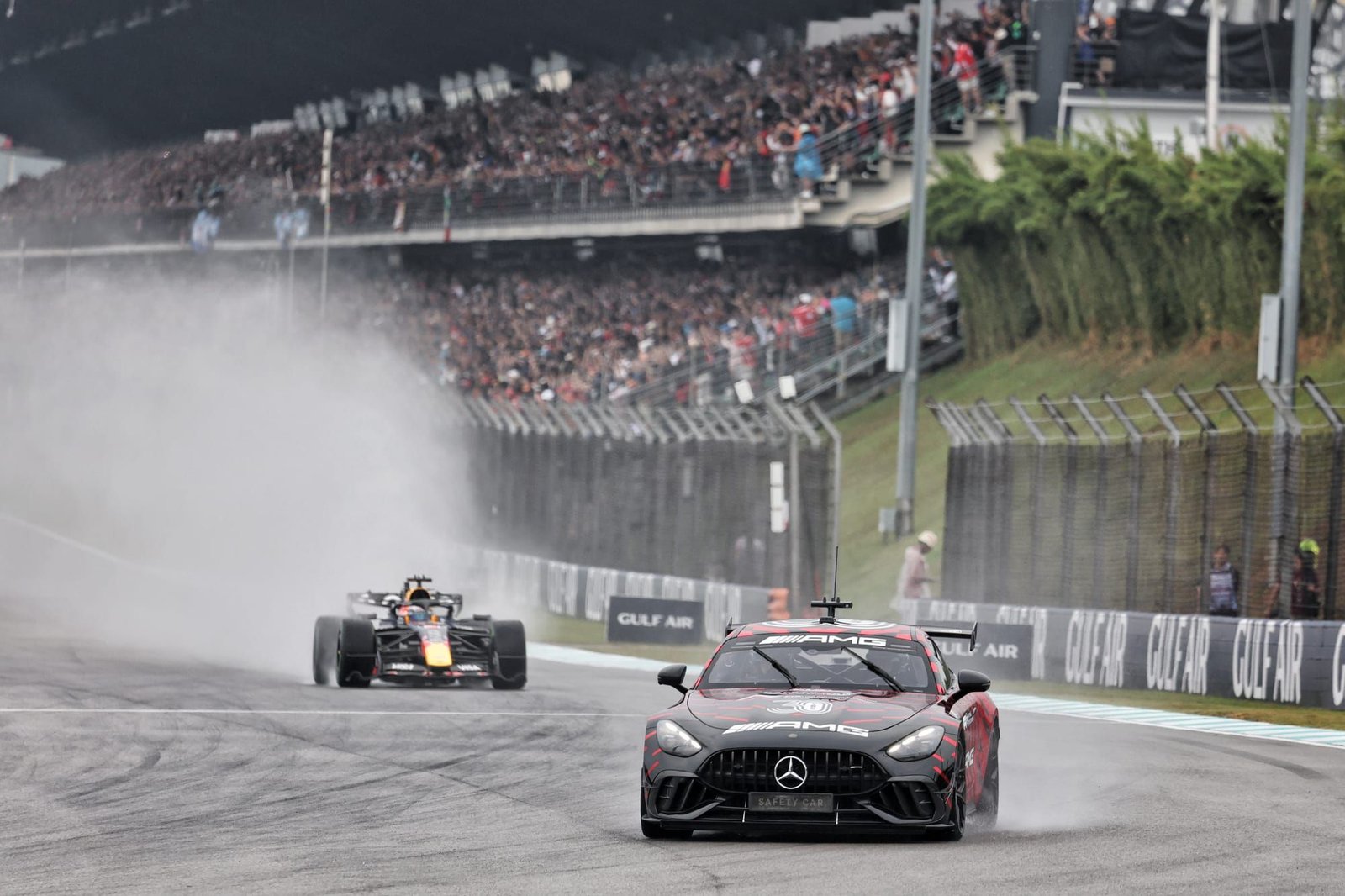
Formula 1’s return to Sepang was supposed to be about racing. Instead, before the Bahrain Grand Prix in Malaysia had even properly started, the sport found itself facing one of the strangest problems of the new regulations. During the formation lap, several cars suddenly suffered power issues, with Lewis Hamilton, Ollie Bearman and Valtteri Bottas among those affected. Engines threatened to shut down, cars slowed dramatically and what initially looked like isolated technical failures quickly became something much bigger.
Race Control eventually red-flagged proceedings, restoring the original grid and delaying the start even further. By the time the race finally got underway, the delay had stretched to around an hour and a half. The culprit was not an engine failure in the traditional sense. It was software.
WHEN THE SOFTWARE TAKES OVER
The 2026 power units have significantly increased the electrical contribution, with the new generation effectively built around a much closer balance between combustion and electric power. But in wet conditions, that electrical deployment needs to be controlled. The FIA limits the available electrical power to 250kW rather than the usual 350kW, and Sepang represented the first time the new power units had properly encountered wet conditions during a Grand Prix weekend.
Three hours after the incident, the FIA finally explained what had happened.
According to the governing body, an unprecedented combination of low engine speed, low grip and wet conditions caused an unintended loss of power on several cars. The FIA technical department therefore removed the energy limitation through a software update that was distributed to every team. Nikolas Tombazis, FIA Single-Seater Director, later revealed just how unusual the circumstances had been.
Some drivers were travelling so slowly behind Max Verstappen during the formation lap that their cars almost reached neutral. That triggered a software issue that prevented engine power from returning normally. And suddenly Formula 1 had something resembling an IT emergency in the middle of a Grand Prix. FIA engineers identified the problem, modified the software and had teams install the update on their cars in approximately 20 minutes. Technically, that is an impressive response. The bigger question is why Formula 1 found itself in that situation in the first place.
A PROBLEM NOBODY HAD TESTED
Perhaps the most worrying part of the incident is that neither the FIA nor the teams had encountered the problem before. There has not been a single wet track session during the 2026 Grand Prix season so far, while the wet-weather power mode introduced in Miami had only seen limited running during a Red Bull tyre test at Suzuka. “We haven’t tested it as much as we would have liked,” Tombazis admitted.
The FIA will now investigate the issue alongside the teams and all five power-unit manufacturers – Mercedes, Ferrari, RB Ford, Audi and Honda – as well as the standard ECU supplier Magneti Marelli.
But Sepang has also reopened a debate that had started long before the first race of 2026.
Drivers have never been completely convinced by this generation of cars. Complaints were particularly loud at the beginning of the season before gradually becoming less prominent as everyone adapted. Malaysia brought them back immediately, and this time, almost nobody held back.
“IT WAS ONLY A MATTER OF TIME”
Carlos Sainz offered perhaps the clearest explanation of the frustration. For him, Sepang should not simply be treated as an isolated FIA mistake. The problem goes much further back, to the decision taken years ago to create power units that depend so heavily on electrical deployment, software and external control. “It was only a matter of time before something like this happened,” Sainz said.
His argument was simple: when Race Control needs to manage power depending on whether the track is wet, dry or somewhere in between, and different maps are required to make that happen, there are inevitably more opportunities for something to go wrong.
“Before, it was simpler and more beautiful,” he added. “Now there are too many complications.”
Sergio Pérez was considerably less diplomatic. “Today was like being in a rental kart and your time suddenly ran out,” he said. “What happened today is completely unacceptable.”
Fernando Alonso, meanwhile, questioned whether all this technology is actually improving the show. “F1 got nervous when Hamilton was off the track. They had to stop the race so Hamilton could get back on the track. It’s the first time I’ve seen something like this,” he said. “There need to be explanations.” Alonso accepted that stopping the race would have been understandable if multiple cars had been stranded in dangerous positions, but argued that the situation hardly justified what followed. “Too much technology that the spectator doesn’t even appreciate,” was his conclusion.
Max Verstappen needed even fewer words. “That’s what happens with these engines. With a V8 you don’t have these problems.”
Others found humour in the absurdity. “They look like remote-controlled cars,” Esteban Ocon joked. “I had to restart Windows.” But behind the joke was the same frustration.
George Russell said there was little else drivers could do but laugh. “Today wasn’t F1,” he said. “If I had been sitting in the grandstands, I would have been disappointed.”
Lando Norris was equally critical, describing the situation as “horrible” and arguing that it demonstrated why Formula 1 should not have so much intervention on the electronic side of the cars.
Taken individually, these comments could easily be dismissed as drivers frustrated after a bizarre afternoon. Taken together, they reveal something more significant.
Formula 1 spent years developing a new generation of power units designed to make the championship more relevant to manufacturers, increase the electrical component and move the sport towards a more sustainable future. Sepang exposed the other side of that ambition.
Modern Formula 1 cars have become extraordinarily sophisticated machines. But when software designed to control their electrical power can contribute to stopping a Grand Prix before it has even started, it is reasonable to ask whether sophistication has crossed into unnecessary complexity.
SEPANG STILL DELIVERS
The irony is that once the technical chaos was finally over, Malaysia delivered exactly what Formula 1 had hoped for: an exciting race at one of the championship’s most popular former venues. And that could become particularly important. There are growing suggestions that Formula 1 and the Malaysian government could be discussing a permanent return of Sepang to the calendar. Nothing is confirmed yet, but after nearly a decade away, the circuit once again showed why it has been missed.
Sepang has elevation changes, long straights, heavy braking zones, fast corners, unpredictable weather and enough width for drivers to actually race each other. The 2026 cars may have complicated Formula 1’s return to Malaysia. The circuit certainly did not.
If anything, after an afternoon in which the sport’s newest technology created one of its strangest problems, Sepang provided a reminder that sometimes Formula 1 works best when the cars are allowed to do the simplest thing of all:
Race.