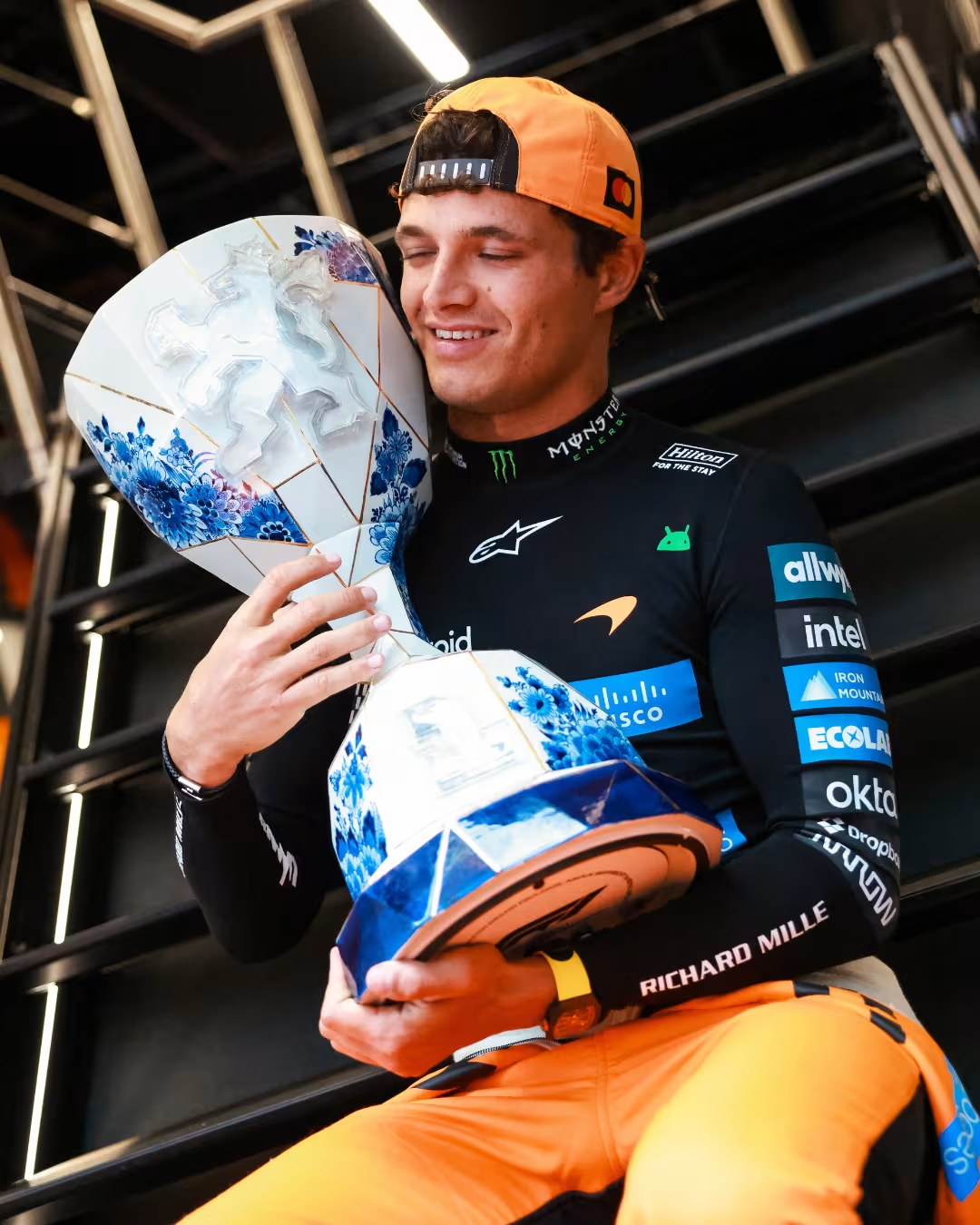
The Dutch Grand Prix once again proved why Zandvoort remains one of the most unpredictable and challenging venues on the calendar. The final edition of the race in the Netherlands delivered drama from the opening lap, with Lando Norris emerging victorious after one of the strongest drives of his career. While the McLaren driver left the circuit with plenty to celebrate, several of his rivals were left wondering what could have been after a weekend filled with missed opportunities, retirements and unexpected performances.
After the summer break, Lando Norris arrived in Zandvoort needing a strong result to keep his championship hopes alive. Although he secured pole position, his recent struggles against George Russell in the Sprint left some doubts about whether he could convert it into victory on Sunday. Those doubts appeared justified when Norris lost the lead to Kimi Antonelli at the start. However, once the race settled, the Briton showed impressive pace, particularly during the middle stint on the hard tyres. He eventually recovered the lead after overtaking both Antonelli and Lewis Hamilton and managed the race until the chequered flag. The victory marked his 13th in Formula 1 and his second consecutive win, a result that could become an important turning point for McLaren as Norris attempts to reduce the gap to championship leader Antonelli.
Antonelli, however, also had plenty of reasons to be satisfied despite missing out on another victory. The Italian enjoyed a strong start and took the lead from Norris, but ultimately could not match the McLaren’s pace during the later stages of the race. Nevertheless, finishing second allowed him to extend his advantage in the Drivers’ Championship to a season-high 59 points. It was another example of the consistency that has defined his season so far, especially considering that his weekend had not been completely straightforward. After damaging the floor of his Mercedes during Sprint Qualifying and being outperformed by George Russell in several sessions, Antonelli recovered when the most important points were on offer. He now heads to his home race at Monza with momentum on his side, although engine component changes are expected to result in grid penalties.
One of the biggest stories of the weekend was Liam Lawson’s return to Red Bull. The New Zealander was called up to replace the injured Isack Hadjar and found himself back in a team that had dropped him after just two races the previous season. However, Lawson arrived as a very different driver. After an impressive run in the midfield, he immediately adapted to the challenge and delivered a strong performance throughout the weekend. He qualified only slightly behind Max Verstappen and finished seventh in the race, extending his points-scoring streak to seven consecutive events. His performance will undoubtedly strengthen his position as he continues to fight for a permanent seat on the 2027 grid.
Yuki Tsunoda also impressed after being unexpectedly called back into a Formula 1 race seat as a substitute for Lawson. Having never driven a 2026-spec car before the weekend, expectations were understandably limited. However, the Japanese driver quickly found his rhythm and remained competitive against rookie team-mate Arvid Lindblad throughout the weekend. Tsunoda qualified 12th and came close to securing a point after an impressive battle with his former team-mate Pierre Gasly. Although Gasly eventually regained the position late in the race, Tsunoda’s eleventh-place finish was an encouraging result and a reminder of the talent he still has to offer as he searches for a full-time opportunity in Formula 1.
Fernando Alonso also gave Aston Martin something to celebrate after a difficult start to the weekend. The British team had introduced further chassis updates alongside a Honda power unit upgrade, but neither car managed to progress beyond the early stages of Sprint Qualifying or Grand Prix qualifying. Race day, however, told a different story. Alonso managed his tyres effectively during a long opening stint and made a one-stop strategy work to finish ninth. The result gave the Spaniard his second points finish of the season and provided Aston Martin with some much-needed encouragement after several difficult weekends.
Audi also continued to show signs of progress, particularly through Nico Hulkenberg. While Gabriel Bortoleto’s promising qualifying performance was compromised after a difficult start and a spin on the opening lap, Hulkenberg delivered one of his strongest races of the season. The German avoided his spinning team-mate during the opening lap and gradually worked his way through the field thanks to solid pace and tyre management. His eighth-place finish matched Audi’s best result in Formula 1 and represented his second consecutive points finish after a long run without scoring.
Not everyone left Zandvoort with positive memories. Max Verstappen’s final Dutch Grand Prix came to an abrupt and disappointing end before he had even completed the first racing lap. In front of thousands of home fans dressed in orange, the four-time World Champion lost control of his Red Bull after touching the white line at the final corner on a damp track. The contact sent him into the barriers and ended his race immediately. Verstappen had never previously finished lower than second at his home Grand Prix, making the result particularly painful. It was also his second opening-lap retirement of the season and leaves him sixth in the Drivers’ Championship, now 130 points behind the leader.
Williams also endured another difficult weekend as the team’s struggles with pace continued. Neither Carlos Sainz nor Alex Albon appeared capable of fighting for the points, with Albon narrowly outperforming his team-mate in qualifying. During the race, the Thai driver initially gained several positions but gradually fell backwards as the lack of underlying pace became increasingly evident. The situation became even more frustrating when Albon and Sainz made contact while battling outside the points. Although neither driver appeared particularly upset with the incident, the result highlighted the bigger problem facing the team: a car that currently appears unable to compete with its direct rivals.
Haas suffered an equally difficult weekend. The American team struggled with both qualifying and race pace, leaving its drivers with little opportunity to challenge for the top ten. Ollie Bearman endured his worst qualifying session of the season before retiring after only two laps, while Esteban Ocon was also unable to make significant progress through the field. The Frenchman eventually retired on lap 52, resulting in Haas’ first double retirement since the Monaco Grand Prix in 2024. After a challenging weekend, the team will be hoping that Zandvoort represents an exception rather than the beginning of a more worrying trend.
Valtteri Bottas also saw another promising weekend end in frustration. The Finn once again outqualified Sergio Perez, marking the fourth consecutive occasion he has beaten his team-mate over one lap. His opening stint suggested that he could remain competitive against Williams, but the pace gradually disappeared as the race progressed. A hydraulic issue affecting the rear wing eventually forced him to retire, marking his fifth retirement in the last seven events. Reliability has become a major obstacle for Bottas this season, with only Lance Stroll suffering more retirements so far.
Zandvoort delivered another reminder that the championship picture can change quickly. Lando Norris leaves the Netherlands with renewed momentum after closing the summer break with another victory, while Kimi Antonelli continues to build a comfortable advantage through consistency. Lawson and Tsunoda took advantage of unexpected opportunities to strengthen their cases for the future, while teams such as Aston Martin and Audi found encouraging signs of progress.
For others, however, the weekend raised more questions than answers. Verstappen’s retirement in front of his home crowd, Williams’ continued lack of pace and Haas’ double DNF all serve as reminders of how quickly fortunes can change in Formula 1. With Monza now approaching, the next round will offer another opportunity to see whether the trends from Zandvoort begin to establish themselves or whether the championship is once again about to take a completely different direction.
Zandvoort also marked the end of an era, as the Dutch Grand Prix says goodbye to the Formula 1 calendar after bringing some memorable moments since its return in 2021. The circuit has consistently delivered a unique atmosphere, largely thanks to the passionate orange crowds that turned every race weekend into a celebration of Max Verstappen and Formula 1.
Bedankt, Zandvoort!