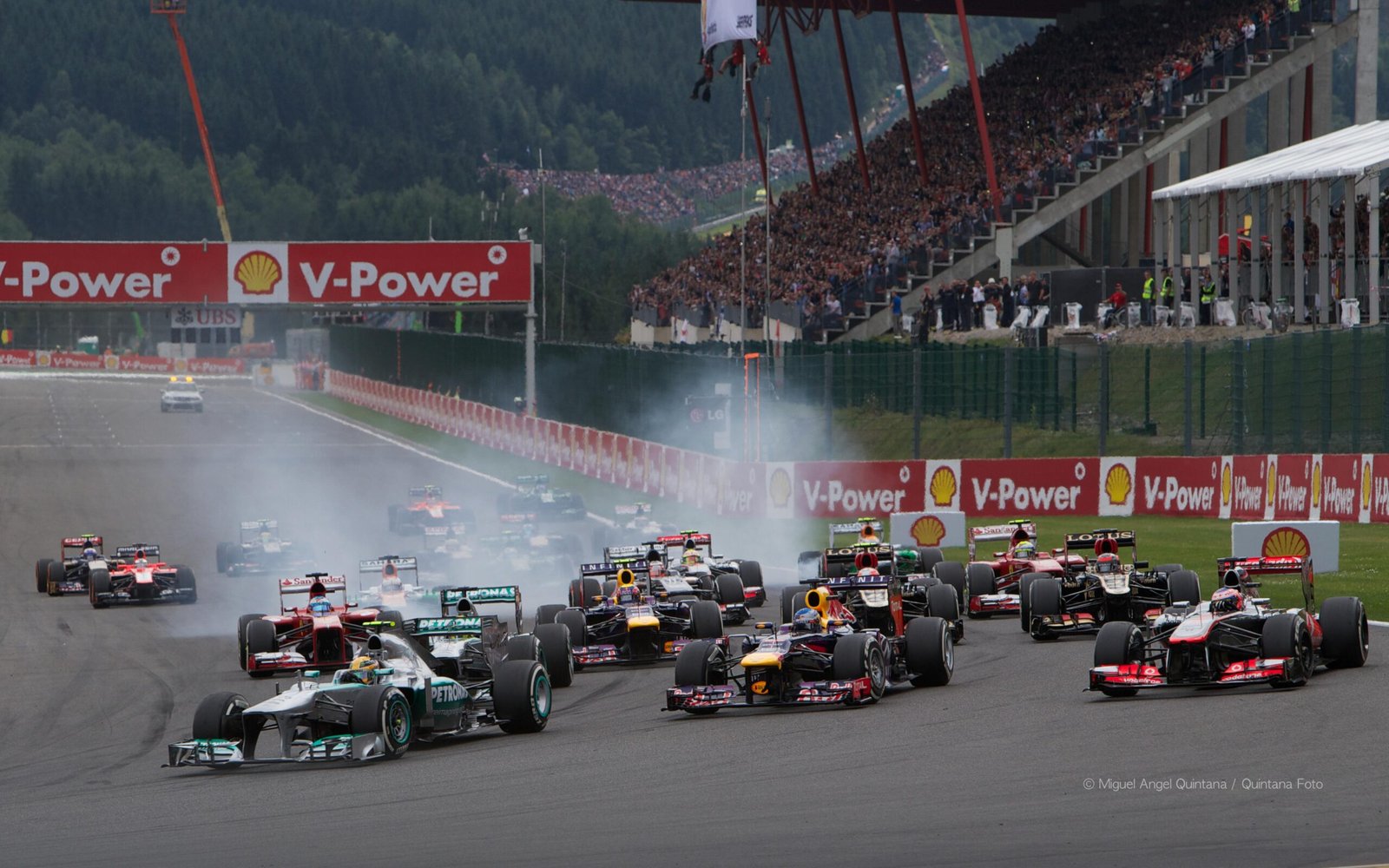
Since the 1970s, Formula 1 has built its identity around circuits that seemed untouchable. Spa-Francorchamps, Monza, Silverstone, and Suzuka were not simply races; they were part of the championship’s DNA. These were the venues where entire chapters of motorsport history were written, where legendary rivalries were born, and where thousands of fans first fell in love with the sport.
But the F1 of 2026 no longer operates solely on the logic of tradition. Today, the calendar revolves around emerging markets, multi-million-dollar contracts, and global expansion. As a result, something that seemed unthinkable just a few years ago is becoming reality: historic circuits are beginning to disappear, rotate, or lose prominence to brand-new venues that have yet to host a single race.
The latest example may be the most symbolic of all.
Formula 1 recently confirmed that the Circuit de Barcelona-Catalunya and Spa-Francorchamps will share a place on the calendar under a rotation system running through 2032. Barcelona will host races in 2026, 2028, 2030, and 2032, while Spa will appear in 2026, 2027, 2029, and 2031.
The announcement sparked mixed reactions. On one hand, both circuits survive. On the other, it is striking that two venues considered essential to modern F1 history must now “take turns” to remain on the calendar, while other circuits with far less heritage enjoy contracts secured for more than a decade.
Because while Spa and Barcelona are fighting to stay, Madrid’s new street circuit—popularly known as “Madring”—already has a contract in place until 2035, despite the fact that it has yet to host a single race and the project itself is still not fully completed.
That perfectly summarizes the direction Formula 1 is heading.
The sport no longer prioritizes history or circuit quality alone. Commercial potential, tourism, sponsorship opportunities, the ability to attract new audiences, and, above all, the amount of money promoters are willing to pay for a place on the calendar now carry enormous weight.
Since Liberty Media acquired F1 in 2017, the championship has aggressively expanded into strategic markets, particularly the United States and the Middle East. Today, there are three Grands Prix in the United States: Miami, Austin, and Las Vegas. Meanwhile, several Middle Eastern nations have become key pillars of the championship, with races in Bahrain, Saudi Arabia, Qatar, and Abu Dhabi.
The problem is that the calendar has a limit.
The FIA and Formula 1 have established a maximum of 24 races per season, meaning that every new circuit effectively forces another venue either to disappear or enter a rotation system.
And that is where traditional European circuits have begun to lose ground.
Perhaps the most painful example for many fans is Zandvoort. The Dutch venue returned to the calendar in 2021 amid the Verstappen phenomenon and quickly became one of the most spectacular weekends of the season, thanks both to the atmosphere created by the famous “Orange Army” and to its iconic corners. However, it has already been confirmed that its current stint in F1 will come to an end this season.
And Zandvoort does not appear to be the last casualty.
Imola also spent years under constant pressure before eventually disappearing from the calendar. The message is clear: no circuit is completely safe.
What is perhaps most striking is that some of the longest contracts on the calendar belong to relatively new races. The Miami Grand Prix, for example, is secured until 2041, while Las Vegas is contracted until 2037, making them among the most protected events in the championship.
Austria is another circuit with a long-term future, although in that case the extension makes sporting and historical sense. The Red Bull Ring has become a hugely popular venue and is deeply connected to the Milton Keynes-based team. Miami and Vegas, however, represent a very different reality: races designed specifically around entertainment, celebrity culture, and the American market.
That is not necessarily a bad thing.
Formula 1 is far more popular today than it was a decade ago. The United States has finally embraced the championship, audiences have grown dramatically thanks to series such as Drive to Survive, and the sport is enjoying one of the strongest commercial periods in its history. New countries want to join the calendar, governments see Formula 1 as a global promotional platform, and Liberty Media is determined to maintain that momentum.
The challenge emerges when expansion begins to feel incompatible with the sporting essence that made F1 great in the first place.
Many fans fear that Formula 1 risks becoming a championship dominated by artificial street circuits, ultra-exclusive paddocks, and races designed more for corporate entertainment than for pure motorsport.
Fan reactions following the announcement of the Spa-Barcelona rotation made that concern abundantly clear. Across online communities, particularly on Reddit, frustration was widespread. Many questioned why Spa should have to alternate while less popular street circuits remain guaranteed a place on the calendar year after year.
And while opinions on the internet can often be exaggerated, they reflect a genuine concern: the fear that F1 may lose part of its historical identity.
Because not all circuits are equal.
Some tracks form part of the sport’s collective memory. Eau Rouge at Spa, the Parabolica at Monza, Suzuka in the rain—these are places that carry decades of stories, accidents, championships, and iconic moments that cannot simply be recreated.
A new circuit may boast spectacular facilities, dazzling lights, and multi-million-dollar contracts, but building history takes decades.
And perhaps that is the fundamental question facing modern Formula 1: how do you continue to grow without losing what made the sport special in the first place?
The reality is that global expansion was inevitable. F1 needed to open itself to new markets in order to survive and compete within the modern entertainment industry. Yet every time a historic circuit disappears or enters rotation, the championship sacrifices a small piece of its identity.
Perhaps that is what the future calendar will look like: a balance between tradition and business. Some historic circuits will remain untouchable, others will have to rotate, and new countries will continue to join the championship.
But what is happening today with Spa, Barcelona, and Zandvoort makes one thing abundantly clear: in modern Formula 1, even the most legendary circuits can no longer take their place on the calendar for granted.